
Ruling out a cut in lending rates, bankers said the status quo policy stance of the Reserve Bank will be followed by them, at least in the near-term.

Raghuram Rajan's signal of a neutral stance is at odds with concerns about inflation and markets' revised expectation of more increases in the repo rate

The economic growth is likely to moderate to 6.1 per cent, slowest in over seven quarters, from 6.6 per cent last year same period.
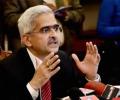
The Reserve Bank of India on Friday decided to leave benchmark interest rate unchanged at 4 per cent but maintained an accommodative stance as the economy faces heat of the second Covid wave.

Experts say the central bank will refrain from using the CRR as a liquidity tool, as a reduction in the rate will go against its current anti-inflationary stance.

In his book, former governor Subbarao says Chidambaram, Pranab were piqued by his tight rate policy.
The Reserve Bank may go for a final 25 basis points increase in the current rate hike cycle next week and a reduction would come in only by the end of third quarter of FY24, economists at Axis Bank said on Wednesday. As per media reports, RBI officials met economists on Tuesday, and the latter have suggested the central bank to go for a 25 basis points hike in key rates. Since May 2022, the RBI has hiked rates by 250 basis points, hurting borrowers and some are already concerned about loan tenors extending beyond their working lives as a result of the hikes.

India Inc could be embarking upon a new phase of capital expenditure (capex) cycle, observed analysts, and suggest its revival would lead to a rerating of industrial stocks. Assisted by a property upcycle, analysts at Jefferies said several government initiatives were likely to drive capex. Indicators, they said, include a private project announcement at Rs 25 trillion for 2022-23 (up 150 per cent from pre-pandemic levels) and credit growth at about 16 per cent, which is closer to pre-pandemic highs.
Home loans and consumer goods loans are likely to remain high as the Reserve Bank of India kept its key policy rates unchanged during its Monetary Policy review on Tuesday.

"The Monetary Policy Committee recognises that there is monetary policy space for future action. However, given the evolving growth-inflation dynamics, the MPC felt it appropriate to take a pause at this juncture," the RBI said in its fifth bi-monthly monetary policy for this fiscal.

Reserve Bank of India Governor Shaktikanta Das tells Anup Roy, Raghu Mohan and Niraj Bhatt that it is time for banks to lower interest rates and start lending to cash-starved finance companies after due credit appraisal and proper risk assessment.

The RBI Governor had earlier cautioned the banks on the risks involved in just hunting for numbers, asking them not to compromise on core objectives of the programme.

Members of the Monetary Policy Committee (MPC) felt that though the Indian economy was resilient in the third wave, it, however, lost some momentum and with inflation likely to soften, there is room to continue with the accommodative stance and support revival, the minutes of the MPC meeting released on Thursday revealed. The six-member MPC voted to keep the policy rate unchanged and continued with the accommodative stance at its meeting on February 10. However, external member Jayanth Verma voted against the stance because he felt a switch to neutral was long overdue and the current stance has become counterproductive and deflects focus away from addressing recessionary trends that date back to at least 2019.

Monetary policy easing, coupled with the relaxation of lending rules and greater election-driven fiscal spending in the first quarter of 2019, will provide some support to growth during the first half of 2019-20 fiscal

RBI Governor Raghuram Rajan on Tuesday kept the repo rate unchanged 6.50 per cent.

The finance ministry will have to rely on the weapons in its arsenal, since monetary policy is not providing the support.

'To the believers of crypto regulations, I have only one question to ask, how will you regulate it?'

'The cost of financing the fiscal deficit will decrease, as new passive investors join in.'

Markets have witnessed a gap down opening mirroring losses in the global equities with US markets taking a hit on worries about the health of Chinese economy.

The Reserve Bank on Friday retained the GDP forecast for the current financial year at 9.5 per cent and flagged global semiconductor shortages, elevated commodity prices and potential global financial market volatility as downside risks to economic growth. In his address after the three-day meeting of the rate-setting panel, RBI Governor Shaktikanta Das said recovery in aggregate demand gathered pace in August-September, and it is reflected in high-frequency indicators, like railway freight traffic; port cargo; cement production; electricity demand; e-way bills; GST and toll collections. "The ebbing of infections, together with improving consumer confidence, has been supporting private consumption," he said, and added the pent-up demand and the festival season should give further fillip to urban demand in the second half of the financial year.

Over the past few months, macro parameters have improved.

Subdued prices of food items like vegetables pulled down retail inflation for the third month in a row to 5.3 per cent in August, within the RBI's comfort zone. While the Consumer Price Index (CPI)-based retail inflation declined to 5.3 per cent in August from 6.69 per cent in the same month a year ago, food inflation dipped at a much faster pace to 3.11 per cent from 9.05 per cent in August 2020. The food inflation was also lower than 3.96 per cent in preceding month of July.

The Reserve Bank of India (RBI) kept its key policy repo rate unchanged at 8.0 percent on Tuesday, as widely expected, while expressing concerns about risks to its target to bring consumer inflation down to 6 percent by January 2016.
The over-recovery on diesel for such companies reached Rs 3.56 a litre for the first fortnight of October.

A fall presents an opportunity to buy rate-sensitive stocks.

Elevated food price-led inflation could become a sore point for markets, which they seem to be ignoring at current levels, observe analysts. Retail inflation in India - as measured by the Consumer Price Index (CPI) - came in at a three-month high of 6.52 per cent in January 2023, compared with 5.72 per cent in December and 5.88 per cent in November 2022. The inflation print for February, according to Madan Sabnavis, chief economist at Bank of Baroda, will be critical for the Reserve Bank of India's monetary policy committee.

The Reserve Bank of India, for the second straight time, on Thursday kept its key policy rate unchanged at 5.15 per cent, maintaining its accommodative policy stance as long as it was necessary to revive growth. The central bank retained GDP growth at 5 per cent for 2019-20 and pegged it at 6 per cent for the next fiscal.
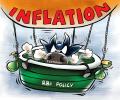
Inflation in food articles basket was 6.99 per cent In May, 2019, down from 7.37 per cent in April. However, onion prices spiked in May with inflation at 15.89 per cent, as against (-) 3.43 per cent in April.

Retail inflation crossed the RBI's comfort level and rose to 5.21 per cent in December on increase in prices of food items.

In February last year, it was (-)2.17 per cent.
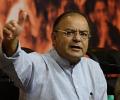
FM says government policies aim to contain inflation, spur growth.

The government plans to bring down its stake to 26 per cent in these two banks, which are yet to be identified. This may not come in the way of getting investors for these banks, provided the government is willing to step back rather than run them the way it had been doing for over five decades since these banks were nationalised, points out Tamal Bandyopadhyay.
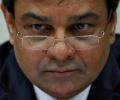
Under Urjit Patel, the then RBI Governor, the central bank had a habit of making complete about-turns on various issues, including electoral bonds and digital payments, former finance secretary Subash Chandra Garg said in his book titled 'We Also Make Policy: An Insider's Account of How the Finance Ministry Functions.' Citing some instances of about-turns by the then RBI Governor Patel, Garg in his book said, RBI had done so on the electoral bond issue and it had so in case of setting up of Payments Regulatory Board (PRB). RBI also made unilateral decisions like ordering complete data localization for participation in the payment system, Garg wrote in the book which will hit the stands on October 1.

Many analysts argue with limited space for a fiscal stimulus, the burden of lifting growth lies squarely on monetary policy.

Traditionally, food prices have been seasonal in nature.

He asserted that it was time to "throw such forces out" to protect "mati, beti, roti" (land, daughter, bread).

In the Sensex pack, Axis Bank, Tata Motors, Infosys, Kotak Bank, HDFC Bank, RIL, Bajaj Auto, SBI, HUL, Tata Steel, Vedanta, HFDC, TCS, ITC and Sun Pharma jumped up to 4.64 per cent.

RBI had previously cut repo rate by 0.25 per cent each in January and March.

After withdrawing record funds in 2021-22, foreign portfolio investors (FPIs) continued their sell-off in the last fiscal too and pulled out Rs 37,631 crore from Indian equities amid aggressive rate hikes by central banks globally. The outflow trend is likely to reverse in the current financial year since India has the best growth potential in the financial year 2023-24 (FY24), VK Vijayakumar, chief investment strategist at Geojit Financial Services, said. Market analysts believe that FPI flows in the current financial year would be decided by a host of factors, such as the US Federal Reserve's policy stance, oil prices movement and development in the geopolitical situation.

The July-September quarter GDP numbers are due on November 30.
